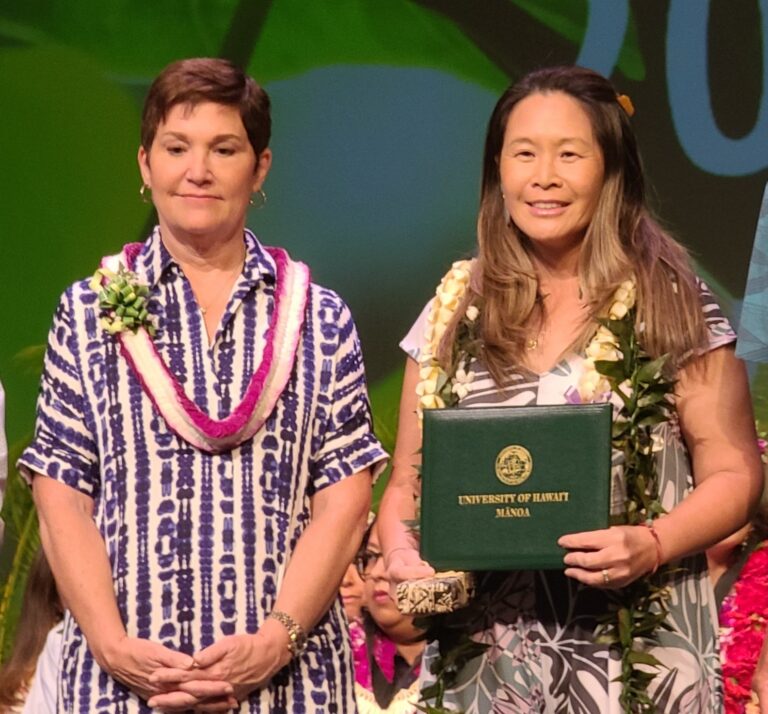
Science in Service of the Ahupuaʻa: Yoshimi Rii’s Work in Heʻeia Receives Dual Honors
Dr. Yoshimi Rii has been honored with the ASLO Fellowship and the Clopton Award for her transformative leadership in the Heʻeia ahupuaʻa, where she integrates high-tech monitoring with a collaborative, community-driven research model. This approach ensures that scientific data is co-developed with local stakeholders to directly empower land managers and shape state water policies.


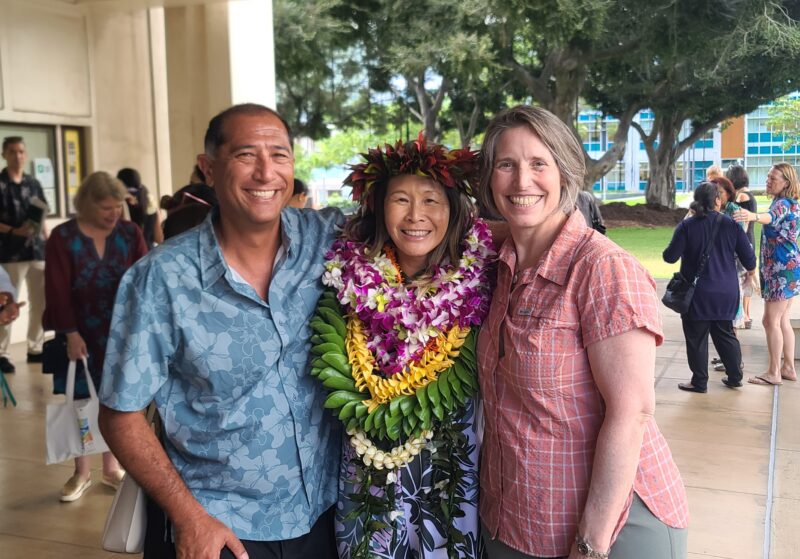
Dr. Yoshimi “Shimi” Rii has been recognized with two major honors this month for her leadership in connecting scientific research with community-based stewardship. As the Assistant Specialist Faculty and Research Coordinator for the Heʻeia National Estuarine Research Reserve (NERR), Rii oversees a portfolio where technical rigor is braided with long-term community stewardship. This month, her work was recognized with the Robert W. Clopton Award for Distinguished Community Service, and with her selection as a 2025 Association for the Sciences of Limnology and Oceanography Fellow.
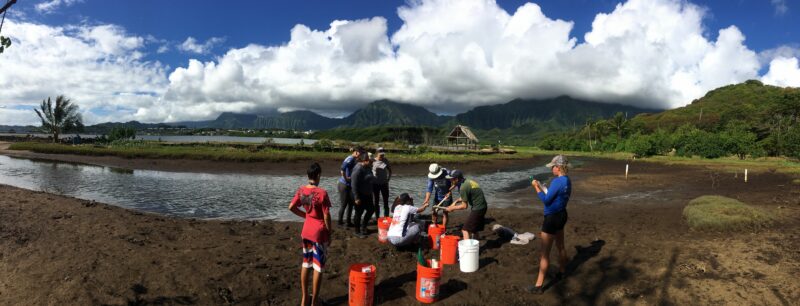
Building Pilina First
The Clopton Award recognizes a UH Mānoa faculty member for playing a socially significant role by applying intellectual leadership and academic expertise towards the improvement of the community. In addition to establishing a nationally applicable, yet place-based monitoring platform for environmental changes in the Heʻeia ahupuaʻa, Rii has also institutionalized a model where relationship-building is the primary methodology to conducting collaborative research.
“Relationship building always comes first,” Rii explains. “Before conducting any research, everyone involved—including students, professors, and agency scientists — should engage in activities to get to know the land, water, and people. The reciprocity can be built through ʻsweat equity,ʻ or simply by being present and listening in the space. Only after building pilina (relationship/connection) in this way can we start having conversations that turn into true, co-developed research.”
Dr. Kawika Winter, Director of the Heʻeia NERR, emphasizes that this approach is foundational to the Reserve’s success. “Shimi’s work is a shining example of how HIMB can transition from a model of ‘research on a place’ to ‘research for a place,'” he notes. “By grounding her technical expertise in the needs and wisdom of our community partners, she has helped us redefine what excellence in estuarine research looks like in the 21st century.”

High-Tech Precision for Ancestral Waters
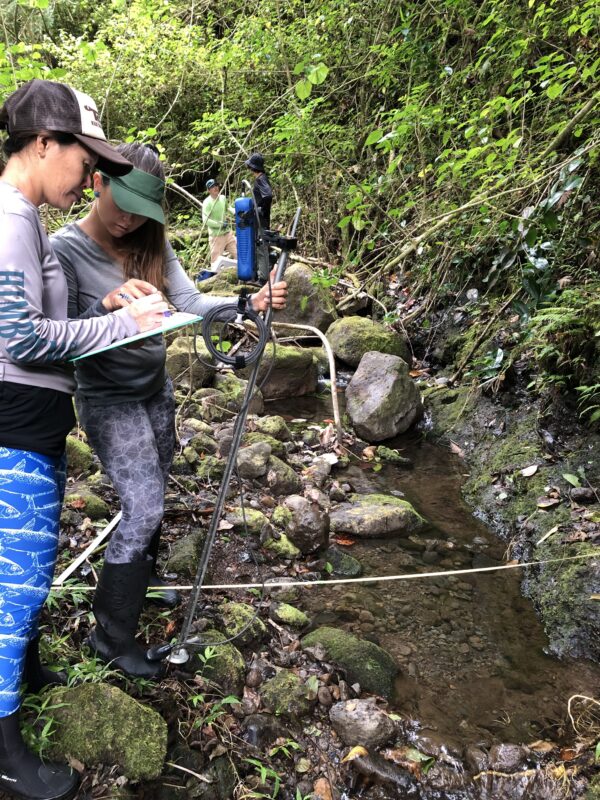
While the foundation is relational, the tools are highly technical. Rii leads the System-Wide Monitoring Program (SWMP), a national initiative of the National Estuarine Research Reserve System (NERRS) that provides standardized, real-time data on water quality and weather throughout the Heʻeia ahupuaʻa.
Within the Heʻeia NERR, Rii’s team ensures that data remains a shared resource for the community. Rather than keeping findings behind an academic firewall, Rii aligns and coordinates informal and formal knowledge exchange opportunities so that community partners can participate in building sensor networks, checking sampling sites, or just talking story about data, and life around them. In addition to the SWMP, Rii and her team engage in a variety of place-specific research projects that aim to answer questions posed by the Heʻeia stewards, such as: “what do the ʻamaʻama [Hawaiian striped mullet] eat, and where are the prey found?”; “how much and what kind of water flow through the Heʻeia ahupuaʻa?”; “what are the nutrient drivers of primary productivity in Indigenous aquaculture systems?”; and “how can we use eDNA technology to monitor fish populations throughout the ahupuaʻa?”.
“Our research projects respond to the needs of the ʻāina stewards,” shares Rii. “They mālama [care for, nourish] the place day in and day out. They have questions about water flow, nutrients, and the time scale of change; our work provides the data to inform their resource management strategies.”
Growing “Whole” Individuals and Influencing Policy
This commitment to the “whole individual” extends to the next generation of leaders. By involving graduate students and young stewards in every phase of the process, Rii is cultivating “dual-fluent” practitioners. These are individuals who are equally adept at building sensor networks and measuring nutrients as they are at navigating the nuances of Indigenous knowledge and data stewardship. Each fall, Rii co-teaches MBIO 600: Kūlana Noiʻi: Introduction to Place-Based Methodologies in Hawaiʻi, a required course for incoming graduate students in the Marine Biology Graduate Program to orient them to “dual fluency” while conducting research in Hawaiʻi.
“Shimi’s work embodies HIMB’s mission to conduct world-class research that is deeply relevant to our island home,” shares Dr. Megan Donahue, Director of the Hawaiʻi Institute of Marine Biology. “She continues to build our knowledge of Heʻeia with ongoing monitoring, while ensuring that research in Heʻeia serves the needs of practitioners and land managers: this is the kind of globally relevant, locally impactful science we strive for.”
The impact of this work reaches far beyond the banks of Heʻeia Stream. Rii’s data has been instrumental in informing Hawaiʻi water policy, including the Division of Aquatic Resources (DAR) Mauka to Makai Water Quality Strategy and the work of the Commission on Water Resource Management (CWRM) to establish Interim Instream Flow Standards. Rii has also co-authored “Forecasting the Ocean: The 2025-2035 Decade of Ocean Science” while serving on the Committee for the National Academies of Sciences, Engineering, and Medicine, incorporating the elements of reciprocity, building pilina, and society-serving research into the priorities for the next decade of ocean science.
“The more wai [fresh water] we have, the more resilient we are to wildfires, sea level rise, and severe flooding,” Rii explains. “In an island ecosystem, what happens in the mountains impacts what happens in the ocean. Our work in Heʻeia isn’t just a localized project; it is a scalable model for climate-resilient research across the Pacific.”
A Model for Collaborative Impact
As environmental volatility increases, the work led by Dr. Shimi Rii offers a blueprint for the survival of island ecosystems. These dual honors reflect a growing recognition that the most impactful science is that which is not only accountable to the site it studies, but actively nourishes it. By fusing technical rigor with an unwavering commitment to mālama, Rii and her team have demonstrated how science can be successfully integrated into the community to drive practical, life-sustaining outcomes.